Thursday, August 24, 2023

LoRaWAN Deployments

 Introduction:

In the rapidly evolving landscape of IoT (Internet of Things) technologies, LoRaWAN (Long Range Wide Area Network) has emerged as a frontrunner, revolutionizing how industries operate and innovate. This article delves into real-world LoRaWAN deployments, shedding light on diverse case studies that underscore the remarkable impact this technology has had on efficiency, cost savings, and innovation across various sectors.

Agriculture: Cultivating Efficiency with Smart Farming

In the agricultural realm, LoRaWAN is fostering a new era of precision farming. Remote sensors powered by LoRaWAN are optimizing irrigation practices, monitoring soil conditions, and tracking livestock health.

One striking example is the "Water Lift Irrigation for Canals" project, where LoRaWAN-enabled sensors and controllers gather real-time data and schedule control, allowing farmers to access water effectively and address potential issues promptly. This data-driven approach minimizes losses, reduces costs, and ensures optimal resource allocation, ultimately leading to increased agricultural efficiency and sustainability.


Smart Cities: Illuminating Urban Efficiency

LoRaWAN is at the heart of transforming cities into smarter, more sustainable entities. By deploying smart street lighting systems, municipalities are conserving energy by intelligently adjusting lighting levels based on real-time conditions, such as ambient light and motion.

Another intriguing case study involves the deployment of LoRa-enabled Manhole Sensors for managing and monitoring the drainage system throughout the city. These sensors provide real-time data on water levels and drainage performance, allowing authorities to address issues promptly and efficiently. Various cities are also using LoRaWAN to manage waste collection, optimize parking spaces, and enhance air quality monitoring. This seamless integration enhances urban living, reduces operational costs, and mitigates environmental impact. 

Logistics and Supply Chain: Streamlining Operations

LoRaWAN's long-range capabilities are revitalizing logistics and supply chain management. Asset tracking devices utilizing LoRaWAN are optimizing inventory control and monitoring goods' conditions during transit.One significant advantage is improved transportation of perishable goods. By tracking temperature and humidity conditions in real time, companies can ensure that goods remain within specified ranges, minimizing spoilage and reducing waste. Additionally, LoRaWAN's long-range communication means tracking can occur over vast distances, leading to substantial cost savings and more efficient supply chain management.

Environmental Monitoring: Empowering Conservation Efforts

In the realm of environmental preservation, LoRaWAN is a formidable ally. Conservationists are leveraging LoRaWAN-enabled sensors to monitor wildlife habitats, track endangered species, and gather crucial environmental data.

LoRaWAN technology enhances environmental conservation by enabling real-time data collection and monitoring. It aids in wildlife tracking, smart agriculture, early forest fire detection, water and air quality management, waste optimization, protected area surveillance, and habitat restoration. LoRaWAN's efficiency contributes to sustainable practices and informed decision-making, crucial for preserving our planet's biodiversity.

Industrial IoT: Revolutionizing Manufacturing

LoRaWAN's reliability and cost-efficiency are revolutionizing industrial operations. Predictive maintenance powered by LoRaWAN is minimizing downtime, reducing maintenance costs, and optimizing equipment usage.

Manufacturers are equipping their machinery with LoRaWAN-connected sensors that monitor various parameters such as temperature, vibration, and performance. This real-time data allows for predictive maintenance, where maintenance activities are scheduled based on actual machine health rather than arbitrary time intervals. As a result, equipment downtime is minimized, and maintenance costs are reduced, leading to increased productivity and cost savings.

Conclusion:

The studies presented here vividly demonstrate the tangible benefits of LoRaWAN deployments across diverse industries. From the agricultural fields to bustling cities and cutting-edge manufacturing facilities, LoRaWAN is propelling efficiency, cost savings, and innovation to unprecedented heights.

As more organizations recognize the potential of this transformative technology, we can anticipate a future where the convergence of IoT and LoRaWAN reshapes industries, elevates sustainability, and ushers in a new era of progress. LoRaWAN's ability to connect, collect, and communicate data over long distances with minimal energy consumption makes it a vital tool for industries aiming to thrive in the digital age while minimizing their environmental footprint.

Thursday, August 10, 2023

Smart Tracking & Alert Management System

Revolutionize your tracking management operations with our cutting-edge Smart Tracking & Alert Management System. Designed to provide real-time tracking and instant alerts based on predefined criteria, this comprehensive solution is your answer to efficient, safe, and compliant operations.

Seamless Integration of Cutting-edge Technologies:

The Tracking system harnesses the power of GPS tracking, Bluetooth Low Energy (BLE), LoRa communication, and intelligent data analysis to empower your management team with actionable insights and timely notifications. Whether you're in warehouse management, industrial tracking, zone tracking, or vehicle management services, our solution addresses the complexities of real-time monitoring, driver behavior analysis, and adherence to routes.

Enhancing Safety and Operational Efficiency:

Safety is paramount to success. This Smart Tracking & Alert Management System ensures the safety of your users by providing a robust and scalable platform. By seamlessly integrating identification devices such as BLE tags, GPS + LoRa + BLE receiver devices, and intelligent data analysis, empower your management team to stay in control and act swiftly.

Key Components Driving Excellence:- The system boasts a scalable and distributed architecture, consisting of pivotal components:-

·         Identification Devices: Unique BLE tags for seamless tracking and identification.

·         Receiver Devices: GPS + LoRa + BLE receiver devices collect vital location and telemetry data.

·         LoRaWAN Network Gateways: Transmitting data to LoRa gateways, ensuring real-time connectivity.

·         LoRa Network Server: Facilitating data exchange and maintaining data integrity.

·         Application Server: The central processing unit for data analysis, storage, and user interaction.

·         Database: Storing historical vehicle data, events, and user information.

·         User Interface: A web-based application for user-friendly monitoring, alert configuration, and analytics.

Diverse Tracking Technologies for specific Needs

  • GPS: Perfect for vehicle and asset tracking, even in outdoor environments.
  • BLE: Ideal for indoor tracking, such as warehouses and industrial facilities.
  • LoRaWAN: Enabling low-power, long-range communication for a large number of devices, ideal for tracking applications.

Unlocking Powerful Features:-

Student Tracking: Real-time tracking within campus premises, automated attendance recording, and emergency notifications.

Employee Tracking: Optimize schedules, monitor productivity, and enhance security.

Warehouse Tracking: Efficiently manage assets, inventory, and personnel for improved operations.

Critical Industrial Tracking: Comprehensive tracking and safety measures for personnel and assets.

Mine Tracking: Enhance safety, optimize resources, and ensure compliance in mining operations.

Emergency Response and Notifications: Rapid response and instant notifications during emergencies.

Elevate your tracking operations with the Smart Tracking & Alert Management System. Experience seamless integration, enhanced safety, and operational excellence.

Contact us to learn more and embark on a new era of tracking efficiency and safety.

Tuesday, August 1, 2023

Overcoming LoRaWAN Deployment Challenges

Introduction

As the Internet of Things (IoT) continues to gain momentum, LoRaWAN technology has emerged as a robust and reliable solution for long-range, low-power wireless communication. However, like any technology, deploying LoRaWAN networks presents its own set of challenges. In this article, we will delve into real-world implementations and discuss the key challenges faced by organizations while deploying LoRaWAN networks. We will also explore valuable lessons learned from these experiences that can help others overcome obstacles and achieve successful deployments.

Coverage and Range Optimization

Challenges: One of the primary challenges in deploying LoRaWAN networks is optimizing coverage and range. Factors such as topography, building materials, environmental factors and interference can affect the reach of LoRaWAN signals, resulting in dead zones and coverage gaps.

Recommendation: Site surveys and propagation testing are crucial to identifying optimal gateway placements and understanding the coverage limitations. Employing Antennas for Signal Amplification or deploying additional Gateways can help extend the range and improve overall coverage.

Gateway and Network Management

Challenges: Managing a large number of LoRaWAN gateways spread across diverse locations can be complex and challenging. Ensuring proper configuration, firmware updates, and monitoring gateways in real-time require efficient network management.

Recommendation: Adopting a centralized Network Management System can streamline Gateway provisioning, Firmware updates, and remote monitoring. Utilizing cloud-based platforms for Network Management provides scalability and simplifies Network administration.


Interference and Spectrum Management

Challenges: LoRaWAN operates in the unlicensed ISM bands, making it susceptible to interference from other devices operating on the similar frequencies. This interference can adversely impact network performance.

Recommendation: Employing the Network out of High Noise Areas, Frequency Configurations enable proactive measures to mitigate disruptions. Leveraging adaptive data rate (ADR)  can enhance network resilience against interference.

Security and Data Privacy

Challenge: Ensuring the security and privacy of data transmitted over LoRaWAN networks is crucial, especially for sensitive applications. Vulnerabilities may arise due to device authentication issues or inadequate encryption measures.

Recommendation: Implementing strong security measures, such as device authentication, encryption, and message integrity checks, is essential to safeguarding data. Regular security audits and updates are necessary to address emerging threats and vulnerabilities.

Power Consumption and Device Management

Challenge: Maximizing the battery life of LoRaWAN devices is essential to reduce maintenance costs and ensure long-term usability. Efficient device management strategies become crucial in large-scale deployments.

Recommendation: Adopting power-saving features, optimizing data transmission intervals, and utilizing deep sleep modes can significantly extend device battery life. Remote Device management ApplicationPlatforms aid in Monitoring device health and Managing Power consumption.

Conclusion

Overcoming challenges in LoRaWAN deployment is vital to unlock the full potential of this technology in diverse IoT applications. Real-world implementations have taught us valuable lessons, and organizations can benefit from these experiences to achieve successful deployments. By optimizing coverage and range, utilizing effective network and gateway management, managing interference, ensuring robust security, and implementing efficient device management strategies, LoRaWAN networks can thrive in a variety of environments.

As the IoT landscape continues to evolve, addressing deployment challenges with valuable insights will undoubtedly lead to enhanced connectivity, efficiency, and innovation in the world of IoT.


Wednesday, July 26, 2023

Enabling Smart Energy Metering with LoRaWAN®


Introduction

As the world advances towards a more sustainable future, the demand for efficient energy management solutions has grown exponentially. In this quest for optimized resource utilization, LoRaWAN® technology has emerged as a game-changer. LoRaWAN®-based energy metering solutions are revolutionizing the way we measure, monitor, and manage energy consumption. In this blog post, we will explore the potential of LoRaWAN® in energy metering, along with the architecture that makes it all possible, paving the way for a greener and more sustainable future.

Understanding LoRaWAN® Architecture

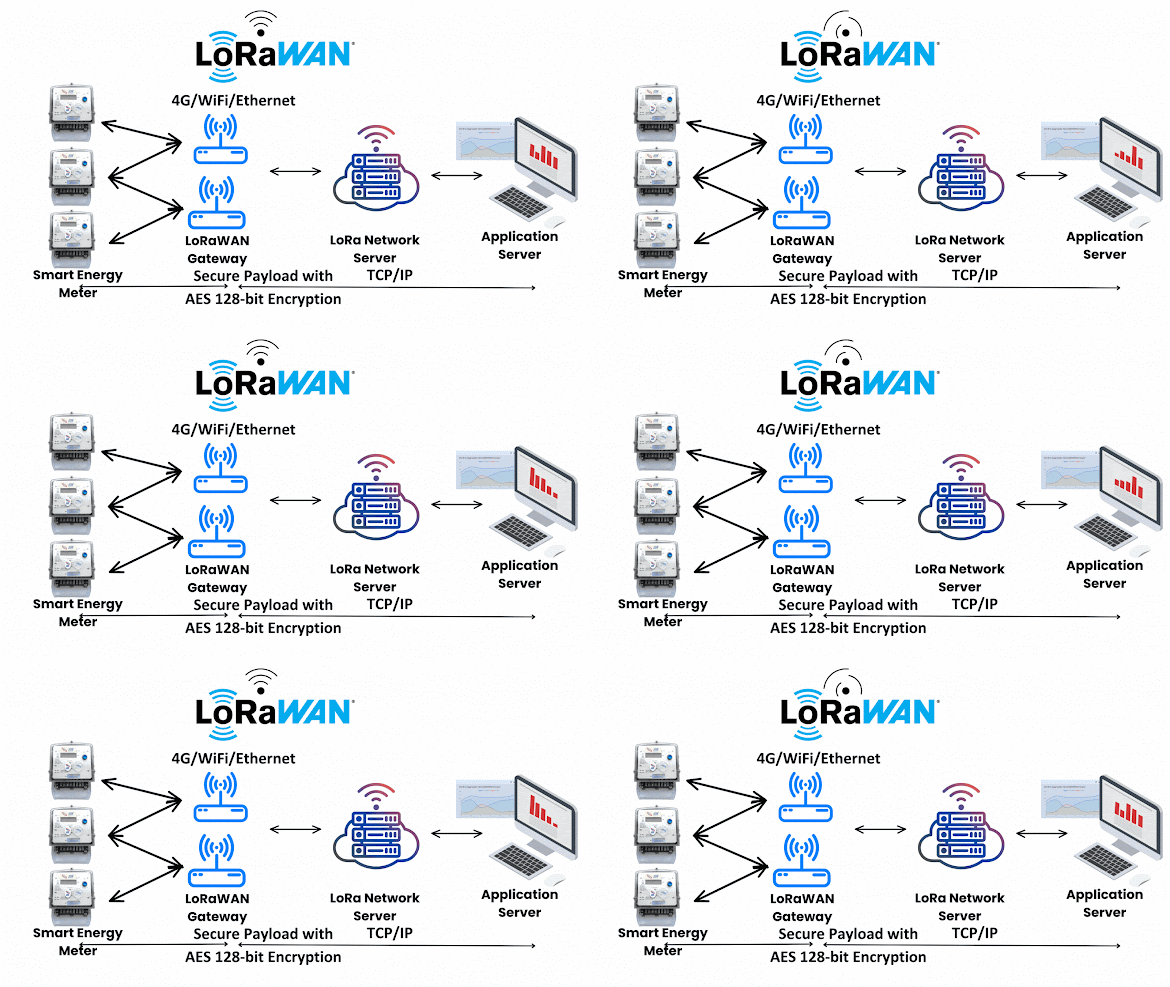
LoRaWAN®, short for Long Range Wide Area Network, is a wireless communication protocol designed for low-power, long-range applications, making it ideal for energy metering. The LoRaWAN® architecture consists of three fundamental components:

LoRa End Devices: These are the smart energy meters deployed at various locations to measure energy consumption. They use the LoRaWAN® protocol to transmit data wirelessly.

LoRaWAN® Gateways: Gateways act as intermediaries between the end devices and the LoRaWAN® network server. They receive data from the energy meters and forward it to the central server.

LoRa Network Server: The network server acts as the backbone of the LoRaWAN® architecture. It manages the entire communication process, including data encryption, authentication, and device management.

Key Features of LoRaWAN®-based Smart Energy Metering Solutions

Reliable and Extended Range: LoRaWAN®'s long-range capabilities ensure seamless communication between energy meters and the central server, even over vast areas, such as residential complexes or industrial facilities. This eliminates the need for extensive infrastructure setup, making it cost-effective and scalable.

Low Power Consumption: Energy meters integrated with LoRaWAN® technology operate on ultra-low power. This significantly extends the battery life of the devices, reducing maintenance requirements and enhancing overall efficiency.

Secure Data Transmission: LoRaWAN® offers built-in security features, ensuring that sensitive energy consumption data remains safe during transmission. Advanced encryption and authentication mechanisms protect against unauthorized access and data breaches.

Easy Deployment and Integration: LoRaWAN®'s plug-and-play architecture allows for quick and straightforward installation of smart energy meters. Additionally, its compatibility with various applications and platforms makes integration into existing systems seamless.


                                            LoRaWAN®-based Energy Metering in Action

·   Real-time Energy Monitoring: LoRaWAN®-enabled energy meters provide real-time insights into energy consumption patterns. This empowers consumers and businesses to track their usage, identify inefficiencies, and make data-driven decisions to optimize energy consumption.

     Remote Data Collection: With LoRaWAN®, energy meter readings can be collected remotely without the need for physical access. This not only saves time and resources but also reduces the carbon footprint associated with manual data collection.

·  Billing Accuracy: LoRaWAN®-based energy metering ensures accurate and tamper-proof data, eliminating the risk of human errors and potential fraudulent activities. This leads to fair and transparent billing for consumers and increased revenue protection for utility providers.

·      Demand Response and Load Management: By analyzing real-time energy consumption data, utilities can implement demand response strategies and load management techniques. This allows them to balance the energy grid during peak demand, reducing strain and avoiding potential blackouts.

Conclusion

The integration of LoRaWAN® technology into energy metering solutions, coupled with its robust architecture, marks a significant milestone in the pursuit of energy efficiency and sustainability. By enabling real-time monitoring, accurate billing, and demand response capabilities, LoRaWAN® empowers consumers and utility providers alike to make informed decisions for a greener future. As the world continues to embrace IoT and smart technologies, LoRaWAN®-based energy metering is set to play a crucial role in transforming the energy landscape and creating a more sustainable and energy-conscious society.

Wednesday, July 19, 2023

Enhancing Automation Efficiency with LoRaWAN

 Introduction:

In the era of smart technology, automation plays a crucial role in enhancing efficiency and improving decision-making processes. LoRaWAN, a cutting-edge wireless technology, has emerged as a game-changer in the realm of multiple sensor automation. By enabling seamless communication between sensors and gateways, LoRaWAN empowers industries to harness the full potential of their automation systems.

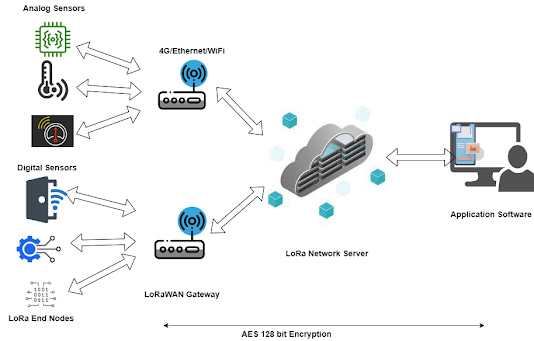
Analog and Digital Sensor automation through LoRaWAN involves utilizing LoRaWAN technology to connect and automate both analog and digital sensors in various applications. 

Analog sensors, such as temperature, pressure, humidity, light, and proximity sensors, provide continuous analog signals corresponding to physical quantities like temperature, pressure, moisture, light intensity, and proximity detection.

Digital sensors, such as motion sensors, limit switches, touch sensors, and provide discrete signals indicating the presence or absence of a specific condition or event.

Analog sensors measure continuous physical variables, such as temperature, pressure, or humidity, while digital sensors provide discrete on/off or binary data.

Here's an overview of how it works:

Sensor Integration: Both types of sensors are integrated with LoRaWAN-enabled modules or devices.

LoRaWAN Connectivity: The sensor modules or devices transmit data wirelessly using LoRaWAN protocol. LoRaWAN's long-range and low-power characteristics make it suitable for connecting sensors spread over large areas or in remote locations.

Sensor Data Transmission: The sensor modules or devices capture analog or digital data and convert it into a suitable format for LoRaWAN transmission. The data is then securely transmitted to LoRaWAN gateways.

LoRaWAN Gateways: LoRaWAN gateways receive data from the sensor modules or devices and forward it to the LoRaWAN network server. Gateways act as bridges between the sensors and the network infrastructure.

LoRaWAN Network Server: The LoRaWAN network server manages the LoRaWAN network, handling data routing, security, and device management. It receives sensor data from the gateways, validates and decrypts it, and forwards it to the application server.

Application Server: The application server receives the sensor data from the network server and performs data processing, analysis, and integration with other systems. It may also trigger specific actions or generate alerts based on predefined rules or thresholds.

 Cloud Integration: The sensor data can be stored and processed in cloud-based infrastructure, enabling scalable storage, advanced analytics, and remote access to sensor data. Cloud integration allows for real-time monitoring, data visualization, and historical analysis.

Data Analytics and Visualization: The collected sensor data, whether analog or digital, can be analyzed to gain insights, detect patterns, and make data-driven decisions. Visualization tools present the data in a user-friendly format, enabling operators to monitor sensor readings and trends.

Integration with Control Systems: The sensor data can be integrated with control systems or actuators to enable automated responses based on sensor readings. For example, if a temperature sensor detects a high temperature, it can trigger an actuator to adjust cooling systems.

Low Power and Extended Battery Life: LoRaWAN's low-power consumption enables extended battery life for sensor modules or devices, reducing the need for frequent battery replacements or maintenance.

By leveraging LoRaWAN technology, analog and digital sensor automation allows for the wireless and efficient monitoring, control, and automation of various physical variables and digital inputs in applications such as environmental monitoring, industrial automation, agriculture, and asset tracking.


Monday, July 10, 2023

Transforming Urban Parking System with LoRaWAN

 A bustling cityscape, where finding a parking spot feels like searching for a needle in a haystack. But fear not, as technology comes to the rescue in the form of LoRaWAN, orchestrating a symphony of smart parking management. In this captivating article, we unveil the magical architecture of LoRaWAN-powered smart parking management that will make parking headaches a thing of the past.

The Smart Parking architecture begins with the Parking Sensors. They take their place by taking individual parking spaces/slots & integrated with the power of LoRaWAN. The Sensing is based on Geo Magnetic Sensing Technology & whenever a vehicle comes over it, the Sensor detects the presence & absence of the Vehicle, captures the data & sends it to the Server through LoRaWAN Gateway. With their mystical abilities, they detect the availability & non-availability of parking slots.

Enter the LoRaWAN Gateways, the backbone of the overall Network. These gateways, stationed strategically across the city, receive the signals from the parking sensors. Like skilled conductors, they check the sensor data and transmit it seamlessly to the LoRa Network Server.

LoRaWAN gateways receive and demodulate simultaneous signals sent by LoRaWAN devices. They receive and aggregate data from devices, decode and process the signals, perform security checks, and transmit the data.

Now the centralized control system or the LoRa Network Server is in action. This Control System receiving the packets of data from the gateways. With a wave, the system processes the information and creates a realm of real-time parking availability. It handles the network authentication, device registration, and security management.

It provides APIs (Application Programming Interfaces) or integration protocols to facilitate data exchange, enabling applications to receive and process data from LoRaWAN devices. The server may also support data storage, data processing, and integration with third-party services.

With the attractive feature of Data Analytics, displaying necessary details like Availability & Non-Availability of Slots, the City Authorities and Parking Operators unveil hidden patterns and trends. They discover the peak hours, the hotspots, and the flow of parking demand. Armed with this knowledge, they make informed decisions to optimize parking operations and create a harmonious parking ecosystem. All this data can be utilized through a Parking Management Application, which shows the decrypted data.

In the realm of smart cities, LoRaWAN technology shines as the key to seamless parking management.

The seamless integration of intelligent parking sensors, LoRaWAN gateways, and a centralized control system creates a symphony of real-time parking availability. This enchanting architecture allows drivers to navigate the city with ease, knowing where parking spots are available at any given moment.


Friday, July 7, 2023

Understanding Data Rates and Spreading Factors in LoRaWAN Technology

 
LoRaWAN offers different data rates to accommodate various communication needs, striking a balance between range, battery life, and other factors. Lower data rates provide longer range, while higher data rates enable faster transmission at the expense of reduced range.

The LoRa physical layer is specifically designed for applications requiring low throughput, low data rate, and a high link budget, enabling long-range communication. Increasing the spreading factor enhances processing gain, sensitivity, and link budget while prolonging the time on air. The orthogonal nature of spreading factors allows for the simultaneous transmission of multiple LoRa signals on the same channel frequency and time-slot. Narrower bandwidth, with a fixed spreading factor, improves sensitivity by reducing the bit rate.

In North America, LoRaWAN utilizes 125 kHz uplink channels and 500 kHz uplink and downlink channels. The maximum packet size in LoRaWAN varies depending on the data rate. Lower data rates support larger packet sizes, while higher data rates reduce the packet size to maintain reliability and efficiency, ensuring compatibility with the network and optimizing performance.

Spreading factors in LoRa refer to the extent of spreading code applied to the original data signal. LoRa modulation offers six spreading factors, SF7 to SF12. By using a larger spreading factor, the signal can travel greater distances while maintaining reliable reception by the RF receiver.

For uplink messages on a 125 kHz channel, four spreading factors are available: SF7 to SF10. It's important to note that the bit rate, estimated range, and TOA values depend on specific environmental parameters and conditions.

Please note that certain limitations on the maximum payload size are in place to ensure compatibility with LoRaWAN networks and optimize overall network performance.

Understanding the spreading factors in LoRa modulation is essential for achieving the desired range and reception quality. By selecting an appropriate spreading factor, data signals can be transmitted over long distances without compromising reliability.

Consideration of data rates, spreading factors, and payload sizes is crucial to ensure compatibility with LoRaWAN networks and optimize overall network performance. Adhering to these considerations enables seamless and efficient communication within the LoRaWAN ecosystem.


Unraveling the Impressive Range of LoRaWAN Technology in Sustainable Connectivity

In the dynamic realm of the Internet of Things (IoT), LoRaWAN (Long Range Wide Area Network) stands out as a transformative force, reshaping...