Saturday, April 8, 2023

LoRa Network Server: Integrated or Cloud Based


We all are now very well acquainted with the LoRaWAN Technology. Smart Homes, Smart Cities, Industrial Automation, Smart Health & Agriculture are some of the areas where this technology gained a foothold idiom.

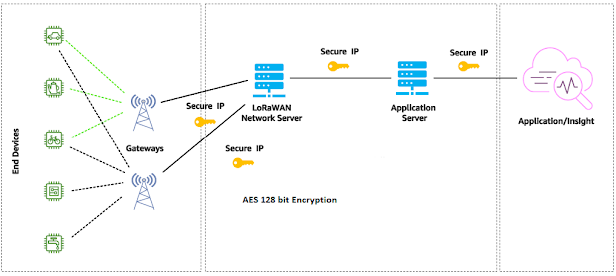
As per the LoRaWAN Architecture, numerous end device sensors are communicating with LoRaWAN Gateways predominantly over LoRa Physical Layer for License free Sub Giga Hertz frequencies.

The Communication requires LoRa Network Server & Application Server because the LoRaWAN Gateway is just like a packet forwarder & acts as a bridge between the End Node Sensors & LoRa Network Server.

The LoRaWAN Gateway listens to all packets coming from the Sensors, in its vicinity & transfers it to Cloud Network. There is an IP connection between the Gateway & the LoRa Network Server.

Here the major key to understanding is why the Network Server is the master of the overall Network System.

The Network Server is the core of every LoRaWAN Network. It enables connectivity, management & monitoring of Devices, Gateways & End Sensor Nodes. The main objective of the LNS is the Reliability, Security & Scalability of Data Routing throughout the LoRaWAN Network.

It validates the authenticity and integrity of devices, de-duplicates uplinks, selects the gateways used for downlink, and sends ADR commands to optimize the data rate of devices. It can also register users, applications, devices, and gateways. This will allow for running a reliable, scalable, multi-tenant network, distributed over multiple regions worldwide.

There are two main types of Network servers, one is integrated & the other is Cloud-based. The Cloud Based Server uses several Datacenter Capabilities with multiple tenants and different Geographical Regions.

An Integrated LNS is one that runs on the same hardware platform as the LoRaWAN Gateway itself, reducing dependency on third-party LNS service providers & helping to realize some economies in individual deployments.

When deciding between an integrated LNS or a cloud hosted LNS (available from service providers such as TTN or Loraiot), it is important to consider the relative strengths and weaknesses of each solution. Generally, if the application only requires a small number of sensors in a localized environment then an Integrated LNS can be a good solution. However, the management and scalability of such a solution will always be more limited than a network (or a network of networks) orchestrated from the cloud.


Friday, March 31, 2023

Water Level Monitoring


Measuring water level is an important task from government and residence side. Thus, existing management systems has to be updated. In this paper, we investigate the water level management using ultrasonic sensor which detects the amount of water present in the tank and returns the percentage of water present in it.

There are various types of Water Level Sensors. But we need to consider few factors when choosing a Water Level Sensor for your Project.

  • Temperature Compensation

This is most important in applications where temperature can vary over time and seasonality.

  • Barometric Pressure

Those in shallow water applications that require a high degree of accuracy.

  •  Sensor Construction

The construction materials are important to the long-term ability of the sensor to perform on site.

  • Power Sources

What power sources are employed is dependent on the sensor and the application, determining if the sensor is taking line/auxiliary power, running on batteries, or in some cases, both.

On 4-20mA or 0-5vDC sensors, the power supply is the communication protocol as well.

  • Analog VS Digital Sensors

Typically, a 4-20mA or 0-5VDC sensor, are considered analog sensors.

It can be programmed for taking readings and user selected intervals or based upon events the sensor detects.  Data collected by these sensors can be downloaded for processing later.

  •  Cable Type

Lastly, what type of cable will the sensor be deployed with? Cables can be made differently based on the sensors used.

Let’s consider for example, one of the Sensor which is trending due to  ease of installation & commonly used for detecting Liquid Level is Ultrasonic Level sensor. It  detects the object and measures the distance by following echo principle. Water is also considered as object when a sound ray strikes water it results in generation of echo which is detected by the echo part of ultrasonic sensor.

By measuring the time duration, distance is determined.

It is integrated with LoRaWAN Module to monitor the information via LoRaWAN.

Next, you’ll need a way to transfer data from your water tank monitor to the User Application. This allows you to track water levels remotely. Here LoRa Gateway will act as a bridge to transfer data from Sensor integrated with LoRa Device to the Cloud Network & further to Application Server.

Advantages:

Non-contact measurement, the measured medium is almost unlimited, and it can be widely used for measuring the height of various liquids and solid materials.

Disadvantages:

The measurement accuracy is greatly affected by the temperature and dust of the current environment, hence it should be the factor which is taken care of while using Ultrasonic Level Sensor.


Thursday, March 23, 2023

Smart Parking Management System


Have you ever experienced roaming in the city & wasting time in searching for Parking Lots? We all have faced the problem of circling around the Streets, looking for any Parking Spots, burning the fuel & time, increases the traffic congestion & ultimately give up & go home.. 

Thanks to the rising Advanced Technology & Standardized Specifications (LoRaWAN) that supports IoT Devices, works wirelessly over RF communication, which results in solving our everyday parking hassles.

With the help of LoRaWAN technology we have introduced smart parking solutions that will eliminate the tussle for drivers looking for the available parking lot, and parking vendors looking to make revenue out of their parking areas.

Let’s see how this can be done, by utilizing the technology we are all familiar with. The picture below depicts the four stages of how we deploy Smart Parking Solutions & reduce congestion, optimize parking time and reinforce traffic laws

Stage 1:

LoRa enabled Parking Sensor has been installed in order to detect the absence, arrival, presence, and departure of a vehicle. A battery-powered occupancy sensor is installed in each parking space. Their low-power design allows the units to run up to 5 years and require no external wiring or additional equipment to install.

Since we all are very well known about the LoRaWAN Architecture on which this system works. Hence, the LoRa enabled Sensor sends Occupancy Data/Signal to LoRaWAN Gateway.

Stage 2:

The LoRaWAN Gateway receives all the data from the LoRa enabled Sensors comes in its vicinity & forwards the complete packets to LoRa Network Server.

Stage 3:

The Server will be Cloud or dedicated Server. This receives the encrypted data comes from the Gateway in a particular Frame Format consists of Unique Mac Addresses assigned to each End Node. The Server will be integrated with User Application.

Stage 4:

The User Interfaces with Web Based or Mobile based Application which display the decrypted payload retrieved from the Server. It shows only user friendly information related to the Occupancy or Vacant Parking Spaces.

City planning officials and Parking management institutions can also create Invoice against the Parkings available in their premises.

There are certain numerous ways through which we can see the Smart Parking System would be more beneficial & economical rather than wasting time & wandering in search of Parking Lots:

v  In order to think over new improvements for a parking service, the city officials must possess the data gathered from the LoRa devices. After that the data can be analyzed to track the frequency of payment violations, spaces that are used the most or off-hour usage, therefore serving as a useful tool for parking officers and local authorities.

v  It reduces the toxic emissions & unnecessary fuel consumption by reaching out directly to the Parking Space.

v  Integrations of the User based Parking Application with Payment Gateway System enhances cashless transactions.

v  Based on the recent Market Research the Global Smart Parking Market will reach US$ 11.2 Billion by 2027, at a CAGR of 25.5% from 2021 to 2027. The growth of the global smart parking market is majorly driven by increase in energy demand due to the rising population & pollution.


Tuesday, March 14, 2023

Smart Street Lighting System

We are aiming towards a new framework for the Smart Cities. Here outlining the Smart Street Lighting System is due to the immense power consumption of the present lighting system. Street Light provision is one of the most expensive but important responsibilities of city lighting which accounts for about 10-38% of the total energy bill in typical cities worldwide. Smart street Lighting system is a project on intelligent illumination control of street lights over LoRaWAN and the illumination of the streets, late in the night. The present/conventional time street lightning is facing many challenges in terms of manPower engagement for Road Lights. In sunny and rainy days, ON and OFF time differ discernibly which is one of the significant hindrances of the present street lights systems. Conventional street lighting systems are on most of the day without purpose because these are operated manually and the consequence is that a large amount of power is wasted meaninglessly.

With the rising adaptability of lighting innovation like Light Emitting Diode (LED) lights and all over accessible remote web association, quick responses, hassle free working, and power moderation factor, increases the success rate to showcase the Smart Street Lighting framework.

 The plan of an automated LoRaWAN based lighting framework which focuses on the saving of power, to construct a vitally energy efficient smart lighting framework with integrated sensors and controllers, which makes the system more user friendly and that requires less involvement of manpower.

All the automations can be made possible via LoRaWAN. LoRa means Long Range, this technology enables connectivity, real-time analytics, reporting, and additional functions such as geolocation. It penetrates in dense urban and deep indoor environments, connecting to sensors which are about 15-30 miles away in rural areas, enables multi-year battery lifetime, supports millions of message per base station, helps tracking application without the use of GPS or additional cause for power consumption, LoRaWAN specification ensures interoperability between different applications, Internet of Things (IoT) solution providers and telecom operators, embedded end to end AES-128 encryption of data ensuring optimal privacy and protection & reduces upfront infrastructure investments, as well as operating and end-node costs.

Steps involved in this model are:

(a) Street Light Controller embedded with each street light have the ability to control light functions.

(b) LoRa Technology in the controller channelizes the communication between the street light to LoRa-based Gateway.

(c) The gateway communicates with the cloud where the data is analyzed & processed by an application server.

(d) Application server monitors & controls lighting system.

(e) The server sends maintenance alerts.

There are various applications where this system can be efficiently planned. For example: If any of the Organization want to automate lights such that they would have schedules for operation, faulty light detection, and events & alerts for various parameters. They also have multiple solutions consists of single and three phase Feeder Panels as well including Street Light Controller unit which can be easily mounted on Light Poles, that would also connect to the Internet to give remote monitoring and control capabilities.

Light Controlling Unit (Street Light Controller Unit)

This controller is having feature to control streetlights through ambient light, commands, scheduling etc. With these features this retrofit street light controller makes streetlight smarter. This controller has LoRa module, through which this controller makes two-way communication. Gateway will work as a mediator between Street light controller and server. A user can send command to streetlight through application to control streetlight. This controller has unique MAC address through which we can map with location.

 Feeder panel (Remote Feeder Control Unit)

The feeder panel can control either single or three phases at a time. On board storage allows the feeder panel to store data collected from each phase, alerts & events detected, and the schedules set by supervisor. This helps in eliminating the need for continuous Internet connection for the solution to work. The feeder panel also houses energy meters per phase, in order to keep track of how much energy is being consumed.

Use LoRaWAN network in smart street-light system certainly change the way of billing and maintenance additionally providing long distance wireless communication. Finally, we can conclude that the system provides 50 - 60% of saving in energy bill.


Saturday, February 25, 2023

The Brain of the LoRaWAN Network: LoRaWAN Network Server


There is no wonder in the statement “The LoRaWAN technology is the key to Smart & Sustainable Future”. There are so many case studies through which we can justify the statement. We can go far beyond the advancement to achieve the

We are so involved in new innovations & development, in order to update ourselves with the changing or demanding future growth. Such contributions can be advanced by having the in depth knowledge of the technology. 

The LoRa technology utilizes the telecommunication network called LoRaWAN which routes the data from the end points to the centralized Network Server & then to the required entities via LoRaWAN Gateway. Since LoRaWAN® network architecture is deployed in a star-of-stars topology in which gateways are the centralized unit which relay messages between end-devices and a central network server. The gateways are connected to the LoRa Network Server via standard IP connections and act as a transparent bridge, simply converting RF packets to IP packets and vice versa.

The LoRaWAN Network Server is connected via IP backbone with the Gateways. The IP traffic from a Gateway to the Network Server can be backhauled via Wifi, Ethernet. The Gateway here acts as LoRa Radio Message Forwarders. The LoRaWAN Gateway then checks the data integrity of the data/messages sent by the multiple End devices within its hearing range called uplink. This also reduces the packet error rate.

For downlink, a LoRaWAN Gateway executes transmission requests coming from the LoRa Network Server.

LoRa Network Server performs data deduplication & deletes all copies & selects the Gateway that received the message with best RSSI.

The LoRaWAN Network Server has following features:

  • v  MAC layer management of uplinks & downlinks, including service messages.
  • v  Network and application layer symmetric AES 128 bit encryption ensuring optimal and integrated security
  • v  Different classes can be assigned to devices depending on the use case to control power consumption.
  • v  Every network management function, including data exposure, can be accessed through a set of open & documented APIs
  • v On selected LoRaWAN devices, the network server can apply decoders to extract application layer data and send it to relevant application
  • v  Providing acknowledgements of confirmed uplink data messages.
  • v  Forwarding uplink application payloads to the appropriate Application Servers
  • v  Routing uplink application payloads to the appropriate Application Server.
  • v  For downlinks, best gateway selection based on availability and radio parameters.
  • v Adaptive Data Rate is used to control spreading factors, power emissions and retransmits to optimize network capacity.

Thus it can be concluded that the LoRaWAN Network Server acts as a brain of the LoRaWAN Architecture which controls the complete LoRaWAN Network. The LoRaWAN Network Server connects the gateways, sensors, end-user applications and ensures reliable & secure data routing for overall LoRa Network.


Tuesday, February 14, 2023

Smart Water Network Management


With increasing concern for water scarcity and growing demand for environmentally sustainable practices, it’s good to remember that even small improvements in water consumption can make a big impact over time.

But to achieve those incremental savings and in order to make sure that your water saving techniques has the favorable effects, you’ll need to improve the accuracy of monitoring by deep dive into the technology you are using.

In addition to the cost effective solutions & saving in consumption, accurate and frequent water measurement techniques also helps you catch and monitor all the possible total flow and leaks before they severely affects the building.

Different magnetic sensors such as reed switches or hall effect sensors are used to detect and assess the magnet rotation, extra electronics generates a voltage pulse proportional to the water flow. In this way it reflects and captures the water consumed.

Different types of water meter are being used for different purposes as follows:


Sr.No.

Pulse Based Output Water Meter (Magnetic)

Ultrasonic Water Meter

Electromagnetic Water Meter

1.

Automatic Water Meter Reading on hourly basis

Automatic Water Meter Reading in real time monitoring

Automatic Water Meter Reading in real time monitoring

2.

Moving parts with a reed switch

Static Meters

Static Meters

3.

Volume of water determined using Pulse

Radiation/Signal based readings

Electromagnetic induction based reading

4.

Insensitive to Temperature, Pressure & Viscosity

Sensitive to Solid suspended particles & air bubbles

Unaffected by the temperature, pressure, density, or viscosity of the liquid


In  order  to transmit the water  meter  data between  meter  and  the users, the system  uses the  LoRa  trans receiver  module which is the AMR unit. The Automatic Water Meter eliminates the hassles & errors in case of Manual Readings Systems. In India, mostly conventional mechanical reading meters are being used, a person needs to go to every meter to note down the reading and then he prepares the bill.

 The AMR has multiple of features to beat the conventional system, which are as follows:

• Easy to use and deploy

• Tamper alert

• Long range wireless data transmission

• Removal detection

• Low Maintenance cost

• Configurable data frequency time

The  final reading  is  thus  sent  wirelessly  from AMR using  LoRa  transmitter  module which  is  at both  the  transmitter  as  well  as  LoRaWAN Hand-Held unit or Static LoRaWAN Gateway.  The Hand-Held unit & Gateway comprising of LoRa module both can cover the distance of up to 2km in urban area and up to 5km when line of sight.


As per the LoRaWAN architecture, the encrypted data then sends to the LoRa Network Server.

A user can also monitor & control the consumption through either Web based or Mobile based Application. The Application has following features:

  1.       Multi-Level Accounts/Logins.
  2.        History Tracking through Downloadable Reports.
  3.        Recharge System: Prepaid or Postpaid both.
  4.      User Registration with Flat Numbers/Ids.


Monday, February 6, 2023

Industrial Automation- IIOT

Hey, the word “Automation” sounds so interesting in the world of technology, isn’t it? So far, we have been upgraded to the world of IoT. This means the interconnection of systems/things via internet, which has sharpened our actions in terms of Consumption of Utilities, Smart Monitoring, Process Control, Data Analysis etc.

IIoT simply means getting information that every single consumer needs in their hands when they want it. The massive chunk of data is very crucial in resolving many Industrial, Cities & Household issues. It is the urge to get rid of human errors and manual actions by enhancing the monitoring & controlling of data in a smarter way.

In this way, the Internet of Things has been introduced to make Smart Devices that drive more efficiency. With most Organizations, the data is not real time & lacks efficiency, inhibiting key stake holders to make informed decisions. Hence, IIoT is introduced to allow making decisions using information received in real time & not from the report generated from yesterday’s data.

IoT has several of applications whether in Smart Cities, Smart Homes, Irrigation Automation, Smart Grids etc. But there is also a word in trend named as “IIoT” means Industrial Internet of Things. The necessity of Industrial Automation, Connectivity & Analytics makes IoT a Super-Hero.

Why IoT is significant among Industrial Automation? Let’s have a look here:

Industrial Automation has been enabled by many technologies but IoT is the crucial one. This transforms the outlook of data monitoring, hassle free controlling, and increased efficiency. Now a days, production sectors rapidly introducing IoT where Machineries can be automated and anticipate possible production hurdles with better efficiency.

The IoT system comprises of:

  •         Smart Devices that captures & forwards the encrypted data over the Internet.
  •          Network architecture that collects & reads the data.
  •          Software Stack displays the processed data & allows monitoring it.
  •          Controllers or Instruments then act by utilizing the same information.

This system has been fitted among Productions Sector, Chemical, Agriculture industries, as well as in Smart Robotics and fixing Security challenges. The growth of IIoT evolves as a way to something bigger.

“The technology that powers an organization has become just as essential to success as the product or service a venture provides,” tech entrepreneur Leon Hounshell wrote in Forbes.

The potential of growth by implementing IIoT is predicted to generate $15 trillion of global GDP by 2030.

The benefits of IIoT have been highlighted as follows:

  •  The contribution of IIoT has made vast changes in economic. The main focus is not on the   Suppliers but on the Consumers which increases business productivity.
  •   It improves operational efficiency, lowers operational costs, and increases income-generation.
  •  Optimization & Process Control of complex data enhances solutions.
  • With IIoT, there are high chances to create revenue generation which helps in expanding   businesses.
  •  Similarly, IIoT devices can monitor and better manage an HVAC system.
  •  IIoT works on improving productivity and quality, without burdening resources.

A Prominent Global Leader Robert Cannon has nicely said that “Everything that can be automated will be automated”.

There are many Industries or Companies that deploys Industrial IoT as their use cases. Some of them are Honeywell, Siemens, Litmus etc.

For example: Honeywell’s Connected OEM is an IIoT platform that allows for remote equipment monitoring to “harness opportunities to cut costs, improve reliability, enhance performance, and drive incremental revenue.”

Litmus creates software that connects industrial devices, both legacy and modern, so industrial companies can access data in real time. The platform works from the edge to the cloud, allowing businesses to manage the entire lifecycle of IoT deployments.

Unraveling the Impressive Range of LoRaWAN Technology in Sustainable Connectivity

In the dynamic realm of the Internet of Things (IoT), LoRaWAN (Long Range Wide Area Network) stands out as a transformative force, reshaping...